
- /
A Newcomer's Guide to the Seven Cities of Hampton Roads
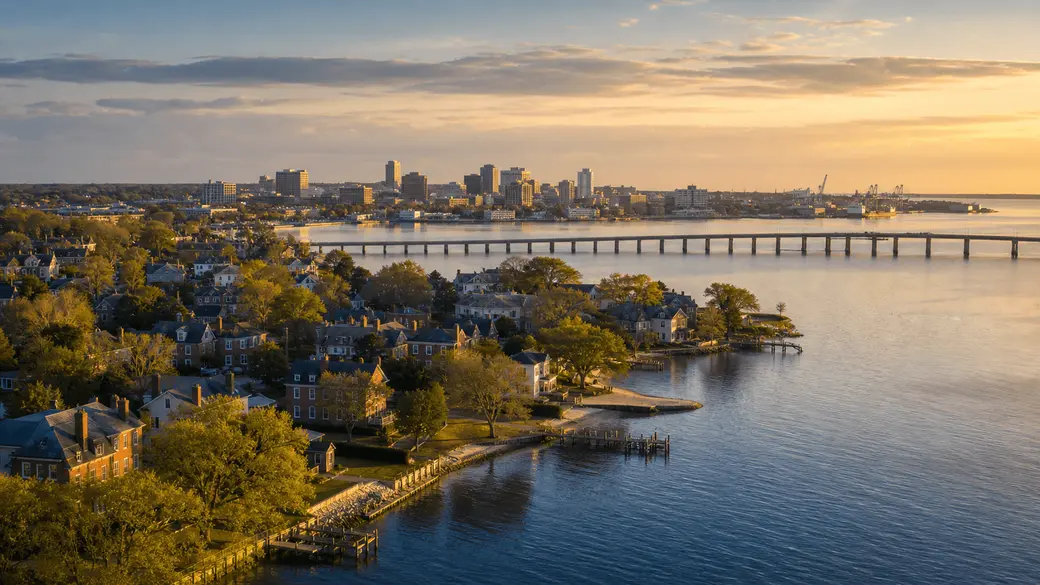
People who move here quickly learn that “Hampton Roads” is not one place. It is a cluster of independent cities wrapped around the water, and each one has its own character, its own commute, and its own housing stock. If you are relocating — for the military, for a new job, or simply for the coast — the fastest way to narrow your search is to understand how the cities differ.
South Side: Virginia Beach, Chesapeake, Norfolk, Portsmouth and Suffolk
Virginia Beach is the largest city in the Commonwealth, and it is far more than the oceanfront. Beyond the resort strip you will find established neighborhoods, newer subdivisions, and quiet pockets close to the Chesapeake Bay. Buyers often come for the beach and stay for the schools and the variety of price points.
Chesapeake covers an enormous footprint, which is exactly why it appeals to so many families. You can find newer construction with a garage and a yard, older brick ranches on mature lots, and genuinely rural acreage — all inside one city line.
Norfolk is the urban heart of the region: walkable historic districts, waterfront views, museums and restaurants, plus the largest naval installation in the world. If you want character architecture and short commutes, this is usually where the search starts.
Portsmouth sits directly across the Elizabeth River from downtown Norfolk. Its historic districts hold some of the oldest homes in the region, and for buyers who value period detail it remains one of the more attainable entries into waterfront-adjacent living.
Suffolk is the geographic giant of the group — a working landscape of farmland and forest that transitions into fast-growing residential corridors. Buyers who want space, newer homes, and a slower pace without leaving the metro often land here.
Peninsula: Hampton and Newport News
Hampton and Newport News anchor the Peninsula side. Both offer strong value, deep history, and easy access to major employers including the shipyard, Langley, and the region's hospitals and universities. For buyers priced out elsewhere, the Peninsula frequently delivers more square footage per dollar.
How to choose between them
- Start with the commute, not the listing. Bridges and tunnels shape daily life here more than mileage does. Drive your likely route at your actual departure time before you commit to a side of the water.
- Decide how much land you want. The difference between a Norfolk row house and a Suffolk homesite is a difference in lifestyle, not just price.
- Ask about flood zones and insurance early. In a coastal market this belongs in the first conversation, not the week before closing.
- Look at more than one city. Buyers who tour across two or three cities almost always end up with a clearer sense of value.
Local guidance, from someone who lives here
I am Greg White, a licensed Virginia real estate professional with The Realty Group Coastal Virginia. I bring more than 30 years of experience in high-level sales, negotiation, and strategic planning to residential real estate, and I live in Smithfield — so the neighborhoods, the bridges, and the trade-offs are not abstractions to me.
If you are weighing one city against another, let's talk it through. Get in touch, or start browsing homes across Hampton Roads.



eXp Realty
Phone